
Warning: Trying to access array offset on value of type bool in /home3/rainonro/public_html/wp-content/plugins/wp-word-count/public/class-wpwc-public.php on line 123
Lorelei Scarboro didn’t think of herself as an activist. So she was naturally surprised when she was being contacted by newspaper and TV stations to tell her story and explain her work.
I was really, really shocked when a local newspaper reporter actually labeled me as an activist. I never really thought of myself as an activist.”
Loreliei Scarboro (pg 126)
Lorelei tells her story along with dozens of other women in Shannon Bell’s book Our Roots Run Deep as Ironweed: Appalachian Women and the Fight for Environmental Justice (2013). Time and time again, they share how they discover their voices in opposition to Appalachian mountaintop coal mining and become inadvertent activists as they cannot resist the urge to protect their families, communities, and the land they grew up on.
Their hesitancy to claim the title “activist” should not be a surprise. Media coverage frequently connects “activism” with tear-gas and burning cars and almost always overlooks the deeper, richer, personal commitments of those who work to make the world a better place. The journey to activism is different for everyone. As one who has lived in the pastoral, professorial, and now career advising world, I thought I would share seven discoveries that have helped me think about my own inconsequential, irreplaceable activist-ish journey.
1. An Ecological Perspective
Given the politicization of conversations around the environment, it’s hard to say anything about environmentalism that doesn’t immediately get one branded a “tree-hugger” (spoken with a knowing snarkiness). In sociology classes we try to step away from politics and examine some basic realities. For instance, one of the most comprehensive scientific projects we look at is the series of Intergovernmental Panel on Climate Change (IPCC) reports. Every 6 or 7 years the IPCC releases a report that summarizes thousands of environmental research projects from around the world. The sixth report is due out in 2022. In a nutshell, the early reports said things like “we think the planet is warming and suspect human activity has something to do with it.” Now, after reviewing tens of thousands of research projects over decades, the reports say “there is no doubt that the planet is warming and that human activity is having a huge impact.” Sure, if you look hard enough or watch the right internet news sites you’ll find a few dissenters. However the overwhelming majority of the scientific community supports the IPCC conclusions (It sort of makes you wonder what you would do if 99 out of 100 doctors said you had cancer. Would you listen to the 1 who didn’t think so?).
Climate change is just one example of a much broader swath of environmental concerns that include loss of biodiversity, warming oceans that lead to more powerful hurricanes, air pollution, access to fresh water, immigration, and how all of this increases the risks of international conflict. I include an ecological perspective as first on the list of important things I’ve picked-up on for two reasons. First, climate change and environmental degradation is a genuine existential threat. The answers to these ecological questions will dictate whether or not anything can really live on this planet 50, 100, or 500 years from now.

Second, climate change is also a great example of how hard it can be for us to join social movements. Kari Norgaard beautifully illustrates this in her book Living in Denial: Climate Change, Emotions, and Everyday Life (2011). An abundance of interviews with a community in Norway reveals that despite clearly recognizing the dramatic changes in their climate, few people were engaged in social change. There is a sense of disconnect between what people knew and what they thought they could do about it. I agree with Kari when she argues that many Americans feel the same way. That’s where the next six ideas come in!
2. Checking the MAP
As a sociologist teaching social justice courses at the university, one valuable tool I have found is Bill Moyers’ Movement Action Plan (MAP) model for social movements (2001 Doing Democracy: The Map Model for Organizing Social Movements). An image of the model is pasted here (used by permission). Moyers’ book is full of rich insights that are particularly useful for understanding today’s movements. If you’d like to more clearly understand the ups and downs of the #MeToo or BLM movements, this is a great read.
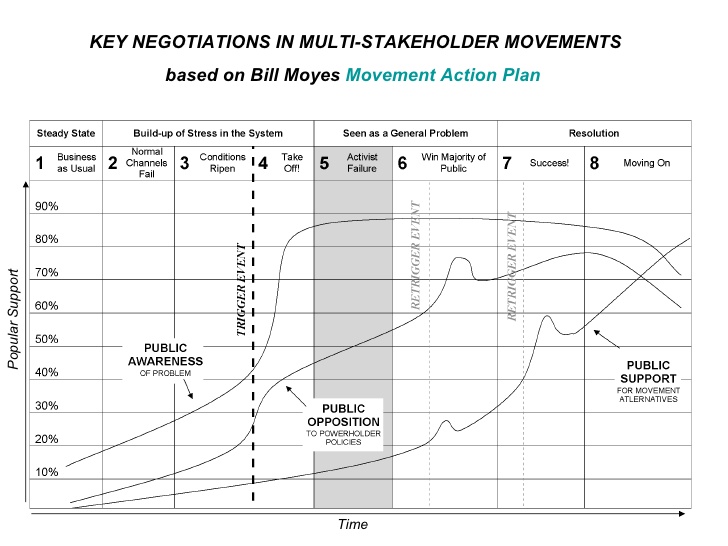
One of Moyers’ most powerful observations is that movements unfold over time and are reliant on people who understand this and keep working at it. Two examples. First, note on the MAP that there are three colored lines representing three different groups of people in a society. One is the percentage of the public aware of the problem. A second is the public’s opposition to current powerholder policies. And a third is public support for movement alternatives. For a movement to accomplish its goals, a greater percentage of the society must move from awareness to active support. This doesn’t happen overnight. It might feel like it sometimes, but what is sometimes perceived as dramatic change is only the result of decades, sometimes generations of work behind the scenes.
A second fascinating observation from Moyers’ years of movement experience is found in his concept of trigger events frequently followed by the perception of failure. These are social moments where something dramatic goes viral on social media or catches the eye of the media (think of the Sandy Hook Elementary School shooting, the arrest of Jeffrey Epstein, or killing of George Floyd). The explosive activism and newfound awareness following these events raises hope that “some progress might really be made this time!” But often, these moments are followed by political wrangling or pushed out of popular attention by the next news cycle, only to be remembered when the next event occurs.
Why does this long-view of social change matter? For those who long for change, Moyers’ MAP reminds us that despite our enthusiasm for the instantaneous (not unlike those body-sculpting exercise machines I keep getting ads for), social change takes time. Which means social movements need people who are willing to keep going for the long-haul. Which means, if we really want to make the world a better place, we need to find a way to keep making small contributions every day for a long time.
3. Gandhi’s Paradox
Our efforts, no matter how large or small, are simultaneously inconsequential and utterly irreplaceable
Another image I’ve found helpful in making sense of my small social justice efforts is described by Alan Johnson in his book Privilege, Power, and Difference (2006). Among lots of thoughtful insights is his reflection on our longing for success and wanting to know that we are making a difference. I confess, I really like the idea that putting a BLM sign in my lawn, sharing progressive posts on social media, going to gender justice training events, joining a march, and writing a blog post now and then, really matters somehow. But honestly, I’m pretty sure that it really doesn’t make a huge difference. And although I genuinely do not expect that my efforts would transform the world, there is a little part of me that has a hard time keeping-on when I don’t see the success I long for.
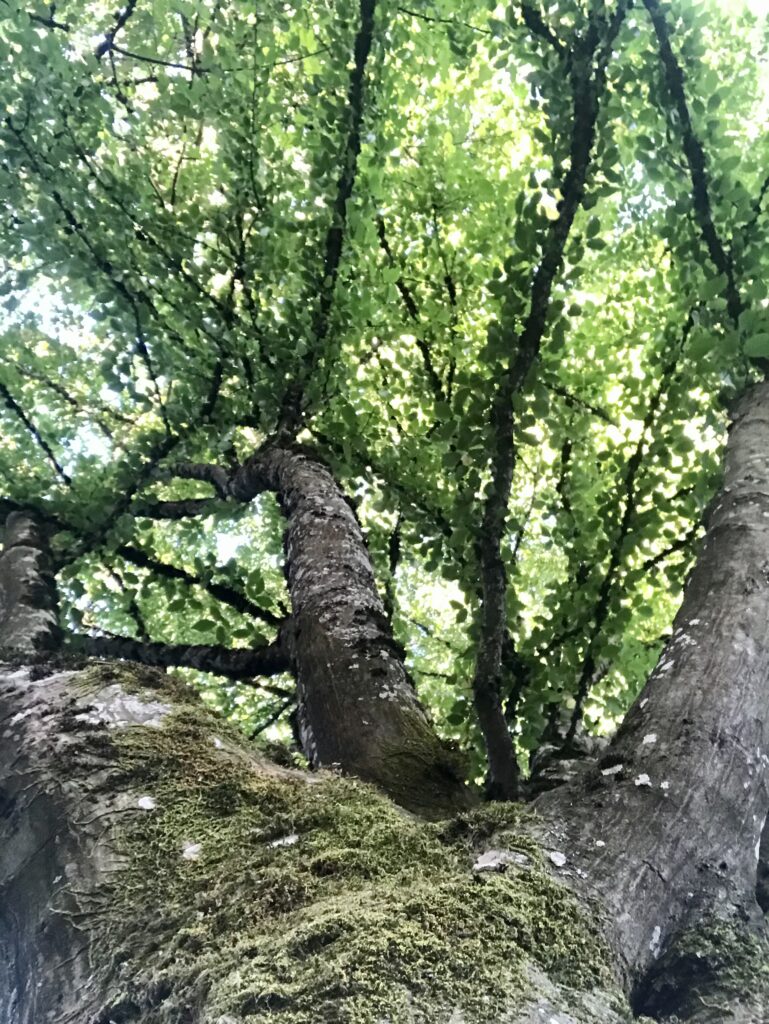
Johnson tackles my disappointment by drawing on Gandhi who once said that “nothing we do as individuals matters but that it’s vitally important do do it anyway” (132). Johnson shares a paradoxical tree metaphor that makes a lot of sense to me. He writes, “no individual leaf on the tree matters; whether it lives or dies has no effect on much of anything. But collectively, the leaves are essential to the whole tree because they photosynthesize the sugar that feeds it. Without leaves, the tree dies.” Our efforts, no matter how large or small we may perceive them to be, are simultaneously inconsequential and utterly irreplaceable in making the world a better place.
4. Don’t Lead When You Can Follow
One of my favorite discoveries is described by Derek Sivers in his TED talk “How to Start a Movement” It is a three-minute watch and well worth it. You should go do that now. Go ahead…I’ll wait. (Pause, I’ll check my instagram…okay, I’m back…) Did you watch it? I know, it’s a pretty grainy video but makes a powerful point (spoiler alert if you didn’t watch the video). As Sivers notes, despite leaders receiving most of the credit, it is the early followers that give a movement it’s credibility.
The first follower is actually an underestimated form of leadership in itself. It takes guts to stand-out like that. The first follower is what transforms the lone nut into a leader.
Derek Siver
If you’ve ever taken a psychology or sociology class, you’ve probably also seen another grainy video. I’m thinking of that old film often called Solomon Asch’s “line-length” experiment. In it a half-dozen 20-something, white, college guys sit together and give their answers to which line from a group they think matches another (you can watch a video of the experiment here…). Typically the exercise is said to prove how hard it is for you (I guess assuming you are a 20-something, white, college guy?) to stick with your opinion in the face of opposition. Everyone else is in on the experiment except one person who has to wrestle with whether or not he’s going to give what is clearly the correct answer when everyone else is intentionally giving the wrong one. Results show that if the subject sensed that he was alone in his answer, he gave in and went along with the majority 37% of the time. However, if Asch placed just one ally in the group to join the subject in standing opposed to the pressure of the majority, the subject gave in only 5% of time.
The long and short of Siver’s and Asch’s observations – people become dramatically more courageous if they have an ally. If you want to make a powerful difference in the world, you don’t have to strike out on your own. Join something that already exists and give others the courage they need to keep going.
5. Liberation Sociology
Another book that was an earth-shaker for me in graduate school was Feagin and Vera’s Liberation Sociology (2008). Their book examines sociology’s struggle to resist the temptation to serve existing powers and instead become a prophetic voice for equity and justice. Much of the book is aimed at professional sociologists and students who anticipate becoming university professors. However, some of their insights are valuable for those outside of academia. One that I carry with me is a sentence that could be easily missed even though it is a major focus of the rest of their work. They write “In this book we underscore the act of choosing what should be studied because this is a crucial and indispensable decision in much sociology practice” (12). For academics, this choice really is crucial. It often has the quality of planting one’s flag in the soil and dictates the rest of their intellectual career.
So what does this have to do with the rest of us? If we want to make a long-term commitment to improving the world, one of the most “crucial and indispensable” decisions we make is to integrate it into our work. I’m not saying we all need to become full-time community activists. I’m suggesting two things. First, that choosing a career direction gives all of us a powerful opportunity to bend our working lives toward justice. Choosing to be a nurse, teacher, firefighter, or social worker puts justice, equity, service, and an awareness of the needs of others front and center everyday.




And second, no matter what our work, we can find ways to bend it toward justice. Financial advisors can show clients the value of socially responsible investing. Business leaders can integrate mediation training into their offices. In my own career development work, our office prioritizes efforts to help first-generation and students of color to find internships that often come more easily to students whose resources allow them easier access to professional networks. You get the idea. No matter where you are you can choose to integrate equality and justice building into your daily work. Where could this work for you?
6. Mr. Holland’s Network
Some of us might remember a 1995 film entitled Mr. Holland’s Opus staring Richard Dreyfuss, Glenn’s Headly, and Olympia Dukakis. In a nutshell Mr. Holland (Dreyfuss) is an aspiring classical musician with dreams of a lifetime of writing music, but who ends up teaching a less-than-mediocre high school band. Although I won’t totally spoil the ending, let’s just say that a lifetime goes by and Mr. Holland discovers that the Opus he writes is less about notes on a page than through the lives in his community.
I can’t disagree with those who say the film is thoroughly schmaltzy. I rarely cry at movies, but this one had me sobbing pretty good some 20 years ago (I’m a little scared to watch it again for fear of what it might do to me now). Tear ducts aside, I am persuaded by one of the film’s foundational observations. Were we to imagine ourselves as composers, the music we produce over a lifetime is less about our daily to-do lists than the confidence and courage we inspire in those we encounter.
If we want to make a real contribution, remember that inspiring others to write their Grammy-winning song is more powerful than writing our own symphony.
A slightly different way to look at this…a key perspective for sociologists who study social networks is that individual nodes of a network (say particular people in a community or workplace or school) are meaningful only to the degree to which they are connected to others and form a network of relationships. The most influential nodes are the ones who have many connections, or sometimes more importantly, who are connected to those dangling out on the periphery. While sociologists have all sorts of statistical ways of measuring these relationships, looking at the connection between social justice and spirituality, social networks give us some new perspectives. The bottom line is that we are only as strong as the web of relationships we are a part of. And should we be the sorts of people who want to make a real contribution to the world, we should be less interested in writing our own symphony than pushing everyone we meet to write their Grammy-winning song.
7. We need spiritual courage and strength
So…confession time. I’m particularly ambivalent about putting spirituality and social justice in the same sentence (I know, that probably sounds a little odd since this whole blog is supposed to be about the intersection of spirituality and social justice). On the one hand, I sense that social justice folks can be really frustrated by spiritual folks who often seem more interested in personal salvation than resisting systemic racism, and visa versa.
On the other hand I see the incredible work being done by leaders like the Dali Lama, Carolina Hinojosa-Cisnero, Jimmy & Rosalynn Carter, or the late Mother Teresa of Calcutta whose faith traditions are central to their work and energy. I know how essential the black church was in support of the civil rights movement in the 1960s, and how the justice work of faith communities continues today (here’s a great example from the sojourners community).
So while the conversation about progressive social justice and spirituality might typically be avoided, it is one of today’s most important conversations. Moyers’ MAP, Gandhi’s Paradox, Mr. Holland’s Network, and the other observations here reveal that anyone who is part of a social movement is in urgent need of spiritual resources and a way to focus beyond our mortal timeline. This is hard work! Perhaps “spiritual resources” isn’t the right word. Maybe it is about connecting with a faith community, or finding a group of friends, or pursuing a regular meditation or yoga discipline. Whatever it is, I encourage you to find it. The pastor and sociologist in me wrestle over all sorts of topics, but one they do agree on is that social progress is exhausting and we have to find some strength beyond ourselves if we want to contribute to the long-term, day-to-day, accumulation-of-the-tiny efforts to build a better world.
rainonrocks.com explores the connection between spirituality and social justice and inspires readers to reach deep and get involved. Matt blogs about spiritual meanderings, career confusion, and wandering voices who think creating a better world is worth the effort. Matt is open to speaking or workshop opportunities. Contact him or see the services section for more information. Subscribe, share with your friends, and suggest topics or people you’d like to get to know.